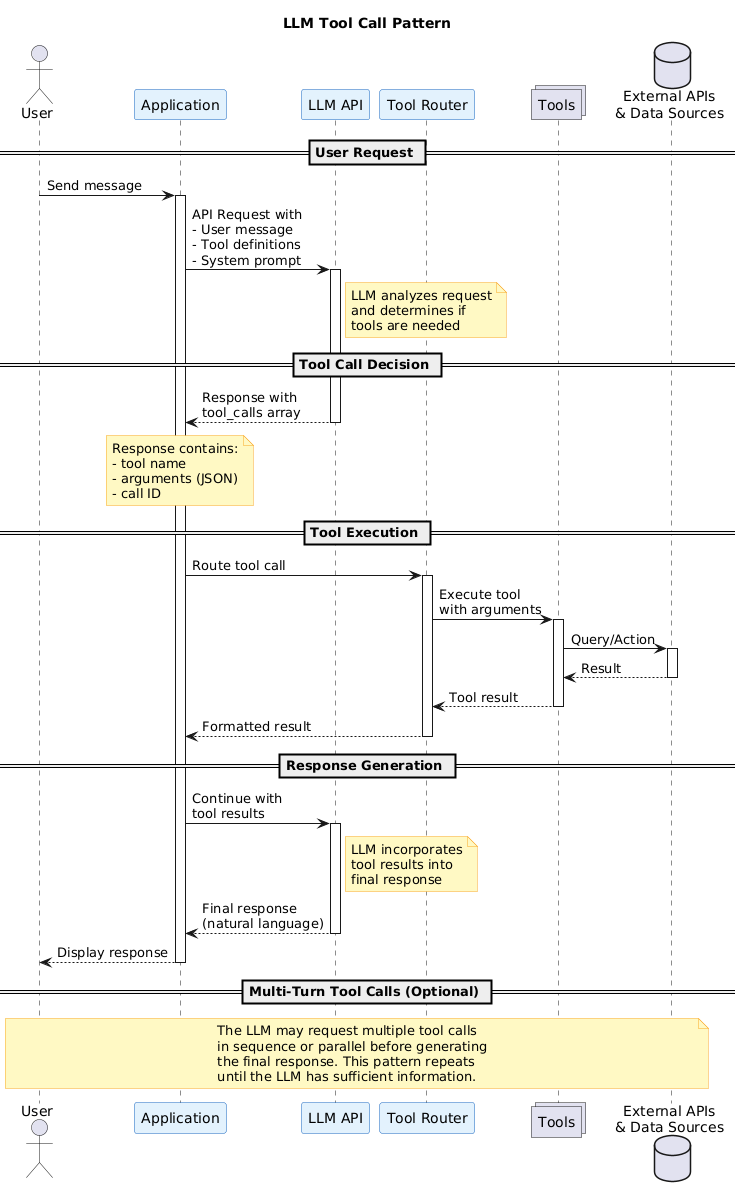
The Tool Call pattern (also known as Function Calling) enables Large Language Models to interact with external systems, APIs, and data sources by invoking predefined tools during a conversation.
This pattern allows LLMs to:
get_weather(location, units)search_database(query, filters)send_email(to, subject, body)calculate(expression)fetch_url(url)| Step | From | To | Description |
|---|---|---|---|
| 1 | User | Application | User sends a message |
| 2 | Application | LLM API | Request includes message + tool definitions |
| 3 | LLM API | Application | LLM returns tool_calls if needed |
| 4 | Application | Tool Router | Route each tool call |
| 5 | Tool Router | Tools | Execute with provided arguments |
| 6 | Tools | External | Query APIs or data sources |
| 7 | External | Tools | Return results |
| 8 | Tools | Application | Return formatted results |
| 9 | Application | LLM API | Continue conversation with results |
| 10 | LLM API | Application | Generate final response |
| 11 | Application | User | Display response |
{
  "type": "function",
  "function": {
    "name": "get_weather",
    "description": "Get current weather for a location",
    "parameters": {
      "type": "object",
      "properties": {
        "location": {
          "type": "string",
          "description": "City name or coordinates"
        },
        "units": {
          "type": "string",
          "enum": ["celsius", "fahrenheit"],
          "default": "celsius"
        }
      },
      "required": ["location"]
    }
  }
}
{
  "role": "assistant",
  "content": null,
  "tool_calls": [
    {
      "id": "call_abc123",
      "type": "function",
      "function": {
        "name": "get_weather",
        "arguments": "{\"location\": \"San Francisco\", \"units\": \"celsius\"}"
      }
    }
  ]
}
| Pattern | Relationship |
|---|---|
| Agentic RAG | Uses tool calls for retrieval |
| ReAct (Reasoning + Acting) | Combines reasoning with tool use |
| Chain of Thought | Reasoning before tool selection |
@startuml

title LLM Tool Call Pattern

skinparam participant {
    BackgroundColor #E3F2FD
    BorderColor #1565C0
}

actor User
participant "Application" as App
participant "LLM API" as LLM
participant "Tool Router" as Router
collections "Tools" as Tools
database "External APIs\n& Data Sources" as External

== User Request ==
User -> App : Send message
activate App

App -> LLM : API Request with\n- User message\n- Tool definitions\n- System prompt
activate LLM

LLM --> App : Response with\ntool_calls array
deactivate LLM

== Tool Execution ==
App -> Router : Route tool call
activate Router

Router -> Tools : Execute tool\nwith arguments
activate Tools

Tools -> External : Query/Action
activate External
External --> Tools : Result
deactivate External

Tools --> Router : Tool result
deactivate Tools

Router --> App : Formatted result
deactivate Router

== Response Generation ==
App -> LLM : Continue with\ntool results
activate LLM

LLM --> App : Final response
deactivate LLM

App --> User : Display response
deactivate App

@enduml