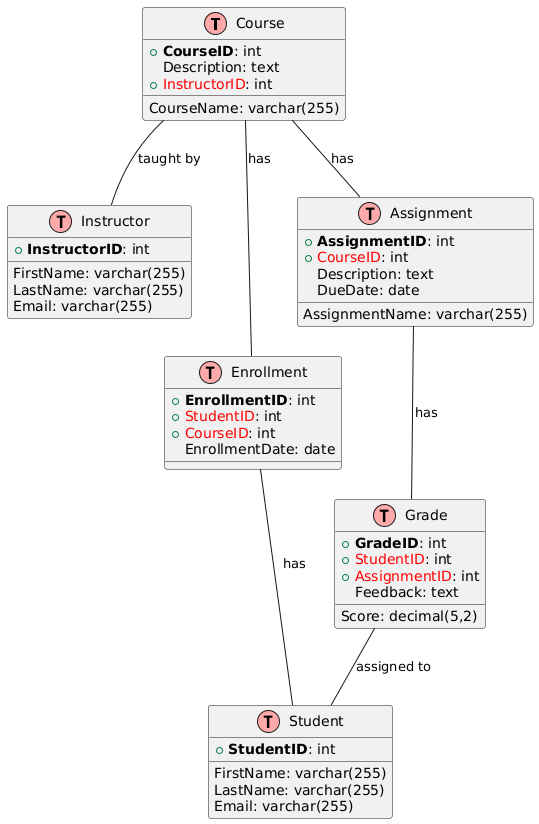
The Learning Management System (LMS) serves as a platform to facilitate online education, manage content, engage students, and track performance. This reference architecture demonstrates the key entities and relationships inherent in a typical LMS.
The primary entities in an LMS include Course, Instructor, Student, Enrollment, Assignment, and Grade. Here’s a simplified ER diagram representing these entities and their relationships:
@startuml

!define table(x) class x << (T,#FFAAAA) >>
!define primary_key(x) <b>x</b>
!define foreign_key(x) <color:red>x</color>

table(Course) {
  +primary_key(CourseID): int
  CourseName: varchar(255)
  Description: text
  +foreign_key(InstructorID): int
}

table(Instructor) {
  +primary_key(InstructorID): int
  FirstName: varchar(255)
  LastName: varchar(255)
  Email: varchar(255)
}

table(Student) {
  +primary_key(StudentID): int
  FirstName: varchar(255)
  LastName: varchar(255)
  Email: varchar(255)
}

table(Enrollment) {
  +primary_key(EnrollmentID): int
  +foreign_key(StudentID): int
  +foreign_key(CourseID): int
  EnrollmentDate: date
}

table(Assignment) {
  +primary_key(AssignmentID): int
  +foreign_key(CourseID): int
  AssignmentName: varchar(255)
  Description: text
  DueDate: date
}

table(Grade) {
  +primary_key(GradeID): int
  +foreign_key(StudentID): int
  +foreign_key(AssignmentID): int
  Score: decimal(5,2)
  Feedback: text
}

Course -- Instructor : taught by
Course -- Enrollment : has
Course -- Assignment : has
Enrollment -- Student : has
Assignment -- Grade : has
Grade -- Student : assigned to

@enduml
This simplified LMS model serves as a basis for understanding the relationships and interactions within a learning management system. It can be further expanded or modified to meet the specific needs of different educational institutions or online education platforms.