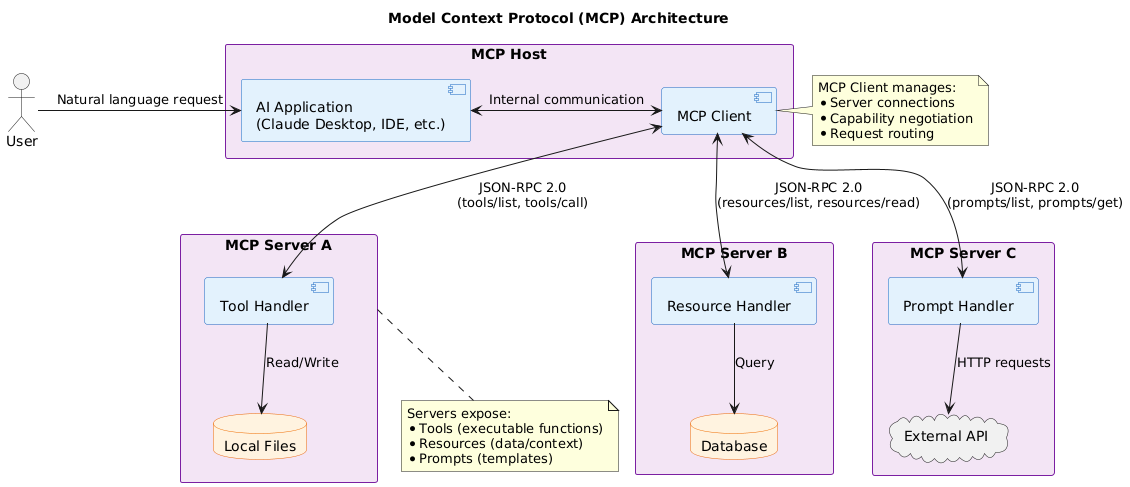
The Model Context Protocol (MCP) is an open standard that enables AI applications to connect with external data sources and tools through a unified interface.
MCP provides a standardized way for AI applications (hosts) to communicate with external systems (servers) using a client-server architecture with JSON-RPC 2.0 messaging.
| Method | Purpose | Example |
|---|---|---|
tools/list |
Discover available tools | List all executable functions |
tools/call |
Execute a tool | Run a database query |
resources/list |
Discover available resources | List accessible files |
resources/read |
Read a resource | Get file contents |
prompts/list |
Discover available prompts | List prompt templates |
prompts/get |
Get a prompt | Retrieve template with args |
{
  "tools": [
    {
      "name": "read_file",
      "description": "Read contents of a file",
      "inputSchema": {
        "type": "object",
        "properties": {
          "path": { "type": "string" }
        }
      }
    }
  ]
}
{
  "tools": [
    {
      "name": "query",
      "description": "Execute SQL query",
      "inputSchema": {
        "type": "object",
        "properties": {
          "sql": { "type": "string" }
        }
      }
    }
  ],
  "resources": [
    {
      "uri": "db://schema",
      "name": "Database Schema",
      "mimeType": "application/json"
    }
  ]
}
| Benefit | Description |
|---|---|
| Standardization | One protocol for all integrations |
| Reusability | Servers work with any MCP-compatible host |
| Security | Controlled access through capability negotiation |
| Composability | Mix and match servers for different use cases |
| Pattern | Relationship |
|---|---|
| LLM Tool Call | MCP standardizes tool calling |
| Skills Pattern | Skills can be exposed via MCP |
| Agent Orchestration | Agents can use MCP for tool access |