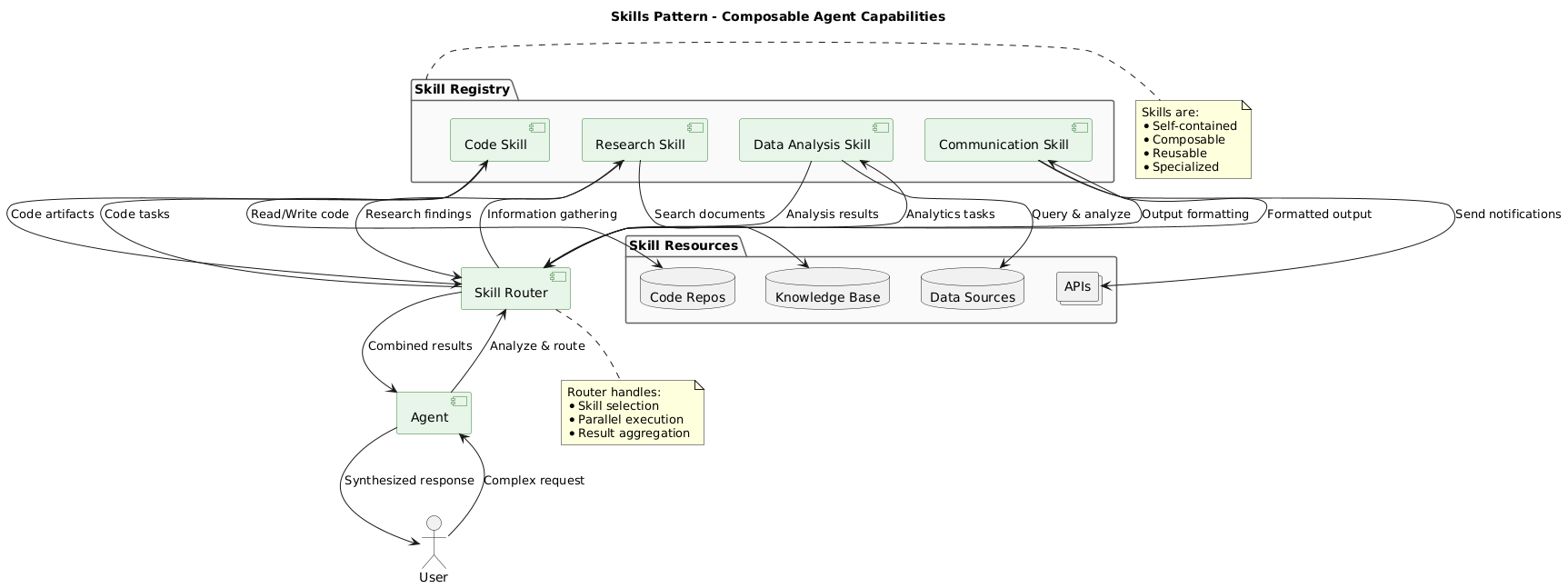
The Skills Pattern organizes agent capabilities into self-contained, reusable modules that can be composed to handle complex tasks.
Skills are specialized capability modules that encapsulate:
An agent can invoke multiple skills to complete complex, multi-faceted tasks.
name: code
description: Write, analyze, and modify code
capabilities:
  - write_code
  - review_code
  - refactor
  - debug
tools:
  - file_read
  - file_write
  - run_tests
  - lint
name: research
description: Gather and synthesize information
capabilities:
  - web_search
  - document_analysis
  - fact_checking
  - summarization
tools:
  - search_web
  - read_document
  - extract_entities
name: data_analysis
description: Analyze and visualize data
capabilities:
  - statistical_analysis
  - visualization
  - trend_detection
  - reporting
tools:
  - query_database
  - run_python
  - create_chart
Skills can be composed in several ways:
| Pattern | Description | Example |
|---|---|---|
| Sequential | Skills run in order | Research → Analyze → Report |
| Parallel | Skills run simultaneously | Code + Test in parallel |
| Conditional | Skills based on results | If error → Debug skill |
| Iterative | Skills in feedback loop | Code → Review → Refine |
{
  "name": "skill_name",
  "description": "What this skill does",
  "triggers": ["keywords", "patterns"],
  "inputs": {
    "required": ["input1"],
    "optional": ["input2"]
  },
  "outputs": {
    "primary": "main_result",
    "artifacts": ["files", "charts"]
  },
  "tools": ["tool1", "tool2"],
  "dependencies": ["other_skill"]
}
| Benefit | Description |
|---|---|
| Modularity | Skills are independent units |
| Reusability | Use skills across different agents |
| Testability | Test skills in isolation |
| Extensibility | Add new skills without changing core |
| Specialization | Each skill optimized for its domain |
| Pattern | Relationship |
|---|---|
| LLM Tool Call | Skills use tools internally |
| MCP Architecture | Skills can be exposed via MCP |
| Agent Orchestration | Orchestrator selects skills |
| Tool Chaining | Skills may chain tools |